

Budgeting for Parking Lot Repairs
Budgeting For Parking Lot Repairs
Encountering unexpected expenses, particularly significant ones, is not something most individuals enjoy. Businesses and government agencies dedicate a considerable amount of time to creating realistic budgets that provide as accurate a representation as possible of their revenue, expenditures, profit, or loss.
While it may be more cost-effective to rebuild an asphalt parking lot than a concrete one, it’s preferable to defer this expense for as long as possible. To avoid unpleasant surprises, it’s crucial to remain vigilant about parking lot repairs and maintenance. You may believe that forecasting the exact amount you should budget for these services is impossible. However, budgeting for parking lot repairs is easier than you think.
Where Should I Start With My Budget for Repairing and Maintaining My Parking Lot?
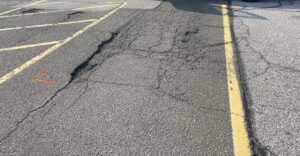
It’s important to familiarize yourself with your parking lot. Gather any documents that can provide information on when it was built, previous repairs, and maintenance. Take a walk around the lot and make notes of any issues you observe, and consider taking pictures. Pay attention to the pavement color, cracks, potholes, markings and signs, and any automotive fluids or debris stains.
With this information, consult a trustworthy asphalt contractor to inspect your parking lot and suggest an appropriate plan. It’s beneficial to attend the inspection so that you can ask questions. To create an accurate budget, ask the contractor to recommend a schedule for crack and pothole repairs, sealcoating, pavement marking, parking lot cleaning, and asphalt resurfacing. The recommended schedules may vary, but several studies have provided average intervals for these procedures.
How Often Should I Repair Cracks and Potholes in My Asphalt Parking Lot?
It’s important to fix any cracks in your pavement that allow water to seep through, as soon as possible. For pavements that are over five years old, it’s recommended to ask your contractor to fill or seal these cracks every autumn and spring. Any potholes should be fixed immediately to avoid any harm to the pavement’s structure and to minimize your liability. To ensure the longevity of your pavement, it’s crucial that all necessary repairs are completed before sealcoating.
How Often Will My Parking Lot Need Sealcoating?
It is recommended to seal parking lots every two years, but the duration depends on the amount of traffic the lot receives. Sometimes, the sealcoating may last for three or more years, or certain areas may require annual touch-ups due to excessive wear and tear.
How Often Should I Stripe My Parking Lot?
After applying the sealant to your parking lot, the existing paint will be obliterated. This means that you will need to reapply new stripes and pavement markings. It is recommended to stripe and mark your parking lot once the paint has lost more than 25% of its original vibrancy. However, if the markings are damaged by snowplows, chemicals, or vehicles, it may be necessary to do it sooner. Generally, painted markings have a useful life of approximately two years.
How Often Should I Clean My Parking Lot?
We recommend scheduling a weekly sweep of your parking lot to keep it free of trash and debris. Additionally, it’s important to thoroughly clean any automotive fluids every six months. While it is possible to do this yourself, please keep in mind that it can be physically demanding.
How Often Should I Resurface My Parking Lot?
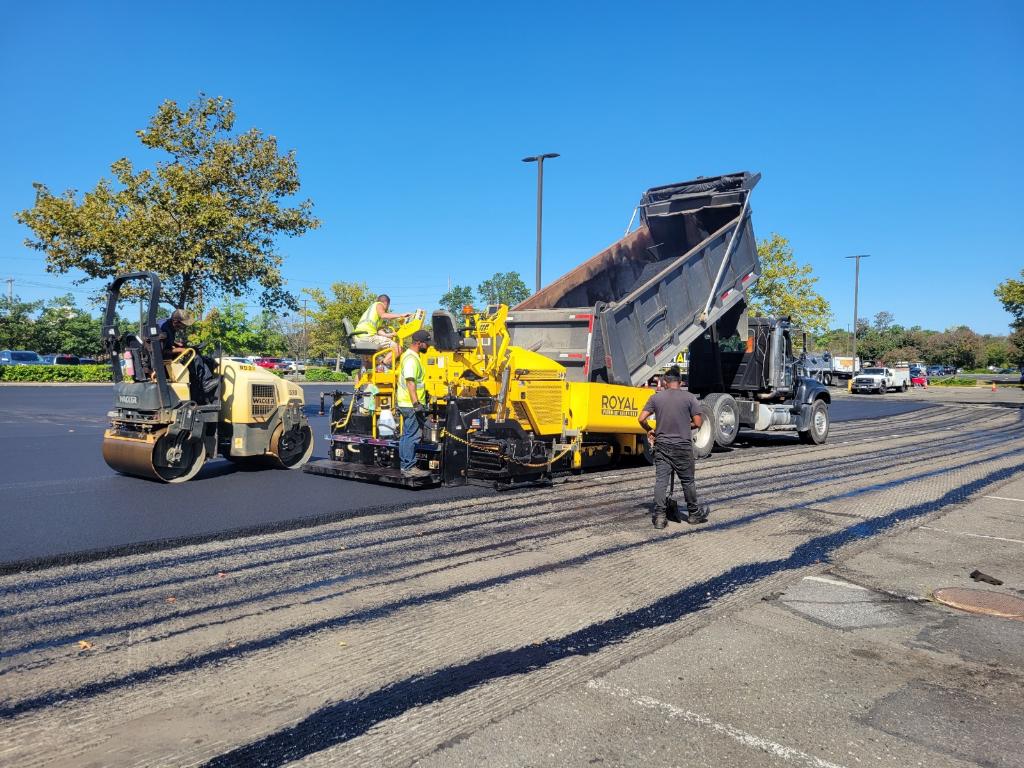
Did you know that resurfacing, which is also called installing an asphalt overlay, can provide you with the benefits of a new pavement at a much lower cost than a complete removal and replacement? This cost-effective solution is suitable for most parking lots, which typically require complete resurfacing every 12 to 15 years. However, if you have high-traffic areas with accelerated wear patterns, you may need a partial overlay every 10 years.
Royal Pavement Solutions Can Help You Care for Your Parking Lot
Our top priority is to help our customers extend the lifespan of their asphalt pavements and ensure that they remain in excellent condition.
Our comprehensive services include crack filling, sealcoating, pothole repairs, overlays, milling, and parking lot striping, as well as site work and concrete work. With our highly skilled and experienced team, we guarantee exceptional results on every project we undertake. To receive a free consultation and quote, please fill out our online form. If you prefer to speak with one of our knowledgeable and friendly team members, please call 844-777-7924.
How To Keep Your Parking Lot Safe – Safety Regulations

In the United States, thousands of accidents happen in parking lots every year. If the accident is between two cars, it is likely that property damage will be the primary or only result. However, if the accident involves a pedestrian or a cyclist and an automobile, the results can be catastrophic. Additionally, a dangerous parking lot can negatively impact your business, leave you vulnerable in lawsuits, or cost you money in fines and penalties. Therefore, this is why parking lot safety is important.
What Are the Federal Regulations for Parking Lot Safety?
First, as a rule, the federal government does not issue regulations for parking lots that are on private property. However, federal statutes could potentially cover three situations. For example, the Occupational Safety and Health Administration considers a parking lot as part of an employer’s premises when determining whether an injury is work-related. Also, an employee completing an assigned task in the parking lot would be covered, but it is also possible that an injured employee walking through the parking lot to begin work would be covered as well. The second situation involves HUD properties. HUD considers parking lots as common areas, and all common areas must be properly maintained so that they are safe. Also, the final federal law to consider is the Americans with Disabilities Act. Lastly, make sure to comply with statutory requirements for slope, grade, surfacing, obstacles, signage, accessible routes, and low-hanging objects.
What Are the State and Local Regulations for Parking Lot Safety?
First, states, towns, and counties are free to enact their own regulations for parking lot safety, so you would need to determine which laws apply at your address. Local and state regulations vary widely, but they frequently address speed limits, fire lanes, speed bump design and placement, signage and turning radius at exits to public streets, and crosswalks. Also, they may also impose special requirements for parking lots serving apartment complexes, hospitals, and educational facilities.
Best Way to Enhance Parking Lot Safety
First, trustworthy and experienced contractors already know the regulations that might apply to your location, and they already know the steps to take to enhance safety in your parking lot. Also, here are a few of the things your contractor will probably recommend.
1. Take immediate action to repair potholes, major cracks, misaligned wheel stops, or other problems that could cause pedestrians to injure themselves. The longer you go without addressing a potential hazard, the more likely you are to lose in a lawsuit filed by an injured pedestrian or cyclist.
2. Line striping, signs, and pavement markings need to be visible, easily recognizable, and properly located. Replace or repair them if they are damaged or faded.
3. Maintain your asphalt sealcoating. Sealcoating mixes contain silica sand, and this enhances traction. Pedestrians will be less likely to slip, and drivers will have less trouble avoiding skids.
4. Keep trees, shrubs, and other vegetation neatly trimmed to eliminate potential hazards. An errant vine could trip a pedestrian, an overgrown shrub could scratch a customer’s vehicle, or a low-hanging tree limb could injure a pedestrian or damage a vehicle.
5. Install and maintain effective lighting. Place powerful lights so that dark shadows that could conceal dangerous objects or criminals are eliminated. Have your employees who work the night shift check all the lights in your parking lot to ensure that they are all operational.
6. Ask your contractor to evaluate your parking lot design for safety. The parking angle, the use of one-way or two-way traffic aisles, the presence of raised islands to prevent drivers from parking at the end of parking rows, and the use of bollards or other physical devices to prevent vehicles from encroaching on sidewalks are all possible methods for improving safety. Your contractor can also advise you on how to design your parking lot to ensure compliance with the ADA.
Conclusion
Royal Pavement Solutions would be happy to help you make your parking lot a safer place for everyone. We offer a number of paving services, including asphalt milling, parking lot striping, asphalt paving, crack repairs, sealcoating, site work, asphalt repair, and concrete work. We are a highly regarded company with a commitment to customer service, craftsmanship, and professionalism. If you are interested in obtaining a free quote, you can request one by submitting the online form. If you prefer to discuss your paving needs in more detail, you can call 844-777-7924.
ADA Pitch and Slope
The Americans with Disabilities Act was signed into law in 1990 and amended in 2008. This comprehensive piece of legislation focuses on protecting the rights of those with disabilities against discriminatory housing or employment practices. However, most Americans are more familiar with the ADA’s provisions that cover accessible parking spaces, routes, and doors. ADA Compliance is the most important when running a commercial parking lot. The ADA also specifies the acceptable properties of a compliant ramp.
ADA-Compliant Ramps
Before continuing, it might be helpful to define some of the terms used in the section of the ADA Compliance that concerns ramps.
• Run: The run, sometimes referred to as the horizontal run, is the length of the ramp.
• Rise: The rise is the total vertical change. For example, four steps that are each six inches in height would represent a rise of 24 inches.
• Slope: Slope is similar to pitch, but slope typically expresses the inches of rise per every 12 inches of run. For example, if a ramp has a rise of 48 inches and a length of 144 inches, the slope would be 4:12. If you want to express the slope as a percentage, you would divide 48 by 144, then multiply by 100, which would give you an equivalent slope of 33.3%.
• Pitch: Pitch, which also refers to the slope ratio, expresses the ratio of the rise to the run. Typically, you express pitch as a fraction calculated by dividing the rise by the run. Using the numbers from the previous example, dividing 48 by 144 yields a pitch of 1/3.
What Are the ADA Requirements for the Slope of Egress Ramps?
The ADA Compliance includes ramps used for accessing a building must have a slope of 1:12, which means that every inch of rise must have 12 inches of run. To illustrate, if the rise is 24 inches, the ramp must be 24 feet in length. The maximum rise is 30 inches, so no ramp or section of a ramp can exceed 30 feet. If a longer ramp is required, it will be necessary to divide the ramp into runs of less than 30 feet, and there must be a landing between the runs to serve as a rest area or turning platform. There must also be level platforms at the top and bottom of the ramp. The ramp’s cross slope cannot exceed 1:48.
What About Other Types of Slopes Covered by the ADA?
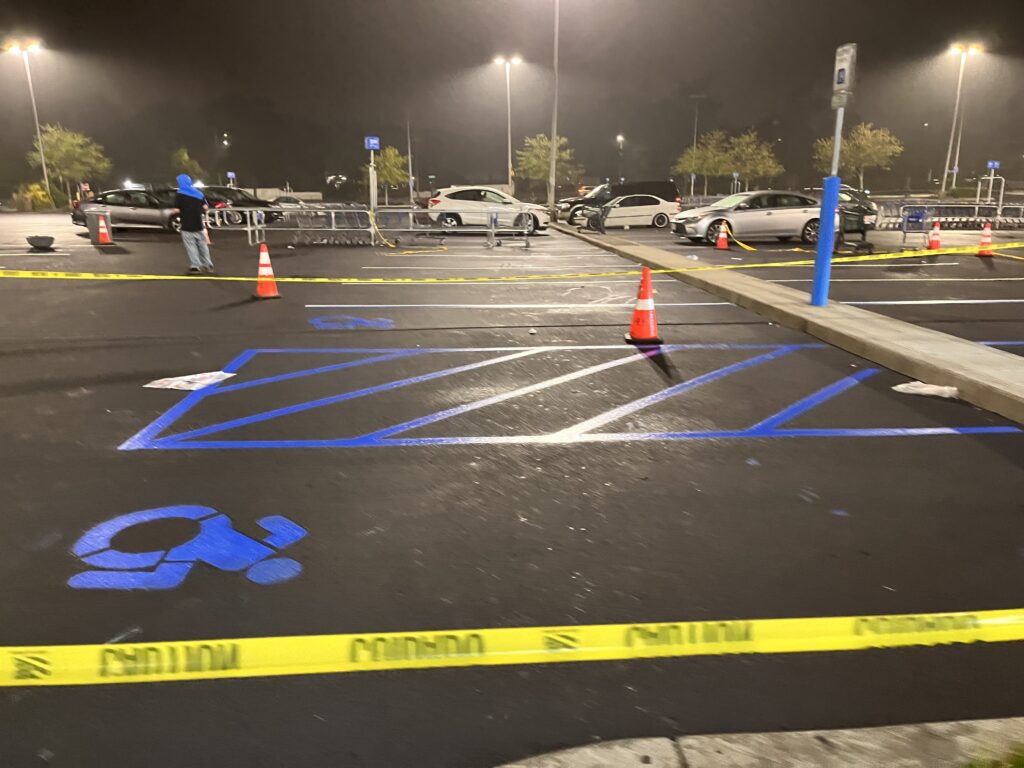
Although most people think of ramps when they consider ADA-compliance based slopes, one commonly overlooked compliance issue involves parking lots. Accessible parking spaces and their adjacent access aisles cannot have a slope of more than 2% in any direction. This can be expressed as a slope of 1:50. Accessible routes cannot exceed 5% slope, and they cannot have a cross slope of more than 2%. Curb ramps are generally required to have a slope of no more than 1:12.
Let Royal Pavement Solutions Handle Your ADA Compliance
ADA compliance is complicated, but we have the experience and training to ensure that your parking lot is in full compliance. We offer concrete work, site work, asphalt paving, parking lot striping, asphalt repair, milling, and sealcoating. We have earned an exemplary reputation by consistently providing exceptional work and extraordinary customer service. You can request a free quote or discuss your paving needs by calling 844-777-7924, or you can use the online form to contact us.


