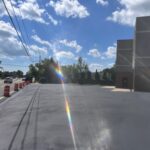
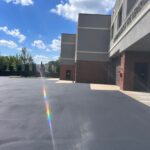
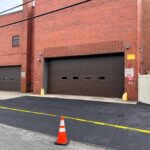
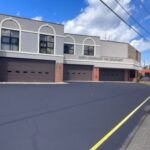
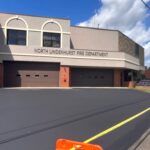
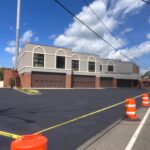
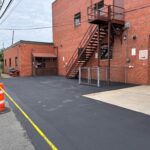
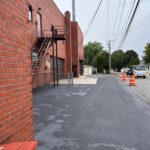
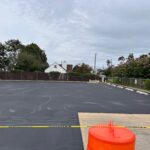
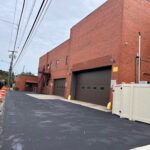
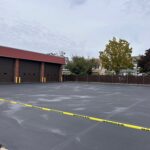
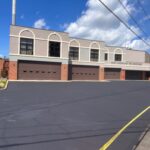
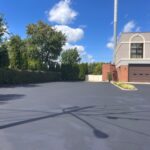
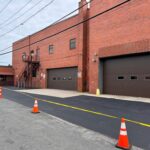
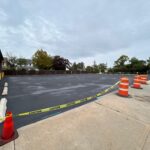
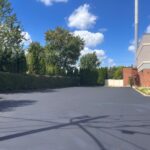
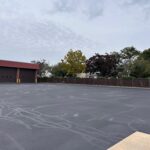
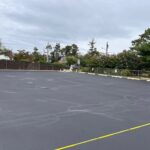
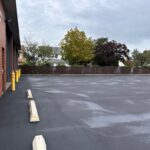
At a volunteer firehouse, pavement is not simply parking space.
It is the surface fire engines and ambulances cross when leaving the building. It is where volunteers park when they arrive to answer a call. And at this Western Suffolk County fire department, that pavement still needed crack sealing, sealcoating, and fresh striping across 30,631 square feet.
Royal Pavement Solutions could not approach the property like a retail lot that could simply be closed for a day. For instance, sealcoat needs roughly twenty-four hours to cure in ideal conditions, and vehicles cannot drive across it during that period. If there was an unexpected emergency, the maintenance work could not impede the firefighters going about their duties.
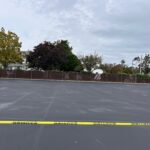
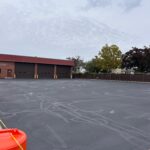
So the project was split into two separate mobilizations: the rear parking lot first, then the main building apron and apparatus-bay area.
The pavement work had to fit around the firehouse, in order to ensure their full and uninterrupted access.
Keeping a Route Open While the Sealer Cured
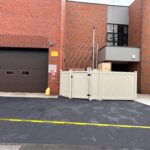
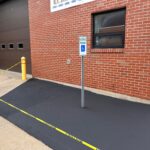
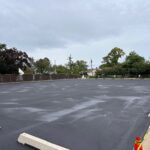
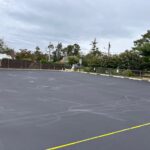
The rear lot covered 14,136 square feet, with 33 standard parking stalls and one handicap accessible stall. The main-building area added another 16,495 square feet, including 17 parking stalls and eight apparatus positions directly tied to firehouse operations.
Each section of the project followed the same sequence: crack filling, sealcoating, cure time, then striping.
This is commonly known as “phasing” a project. The sequence of each phase is important because every next step depends on the one before it. The striping subcontractor cannot paint over uncured sealer, and other equipment can’t roll across a freshly coated surface.
By separating the property into two treatment areas, our crew created two controlled cure windows instead of one property-wide shutdown. At no point was the department unable to answer a call.
For any emergency-services property, phasing means a lot more than just a scheduling preference. In the case of a fire department, it could be a matter of life or death. Royal Pavement Solutions works with every customer to properly phase their work as part of the pavement-maintenance strategy.
What Went Down Before the Fresh Black Finish
Before applying the first drop of sealer, the three-person crew used industrial blowers to clear dirt and loose debris from the pavement.
Across both visits, 2,100 linear feet of cracks were treated with 517 pounds of hot-applied liquid rubber. The scope called for proper over-banding, meaning the sealant was spread across the shoulders of each crack rather than stopping flush inside the opening.
That detail is easy to see after the work is finished. The black bands tracing the cracks are intentional. They help cover the joint where water can work between the sealant and the surrounding pavement.
The remaining work included:
- 600 linear feet of crack sealing in the rear lot and 1,500 linear feet around the main building.
- One heavy, hand-applied sealcoat using 514 gallons across the property.
- Re-striping to the existing layout with DOT-approved traffic paint applied by airless spray.
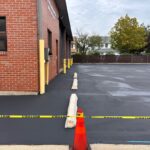
- 50 linear feet of yellow curb marking across three areas.
- Repainting the single lines inside the fire engine and ambulance bays as an added change-order item.
A cleaner-looking flush fill is not necessarily the better seal. On this project, protecting the crack edges mattered more than hiding the repair.
A Firehouse Shows Why Access Planning Matters
This North Lindenhurst project is a useful example for any facility that cannot simply lock the gate while pavement work is being done.
Firehouses make that constraint especially clear. Vehicle and apparatus positions, volunteer parking, drive lanes, and building access all have to be considered as part of the work area before crews ever arrive, not after the coating is already scheduled.
The same planning principle can apply to hospitals, schools, transit yards, distribution facilities, and other properties that need portions of their pavement available around the clock.
For commercial and municipal properties in North Lindenhurst, NY, we can plan sealcoating and crack sealing around real access requirements. Contact us to discuss which areas must remain open and how the work can be phased before pavement maintenance begins.